Split
A walkable, sun-soaked Adriatic coastal city with Roman ruins, top-tier safety and excellent English — but a clunky residency path, worldwide-income taxes, and a dead, rainy winter.
For an American couple, Split runs about $2,550 a month — though the flight home is a long one.
Split by the numbers
Visa & residency for Americans
Croatia has NO retiree/pensioner visa. Retirees use a non-EU Temporary Residence Permit on grounds of financial means (savings, pension, investment/rental income), issued 1 year and renewed ANNUALLY; permanent residence only after 5 continuous years. Statutory minimum jumped in January 2026 to 60% of the prior-year average net salary: EUR 869.40/mo single, EUR 1,086.75/mo couple (~$994 single / ~$1,243 couple; NN 3/2026, 2025 average EUR 1,449). In practice officers still often expect roughly EUR 1,200-1,500/mo per person plus registered local address and private health insurance. Note: the Digital Nomad Visa (EUR 3,622.50/mo as of Mar 2026) requires ACTIVE remote work and does not fit true retirees. The annual-renewal grind and uncertainty are the real pain points.
Your Croatia residency, mapped to your situation
Where you're headed, who's going, and what you're working with — five questions puts your file on the desk. When a visa specialist clears our bar for your country, you're first in line for the introduction.
Map my Croatia visa path →What living in Split is actually like
KBC Split (Firule) is Croatia's 2nd-largest hospital (~1,850 beds) and handles acute/emergency care; the public HZZO system has small co-pays (~EUR 17.70/day, capped ~EUR 530/stay). English is reliable in private polyclinics (e.g. Poliklinika Priska Med, Tourist Doctor Split) but variable in the public ER with older staff. Adequate for most needs; for the most complex tertiary care, Zagreb (KBC Zagreb, ~3-4.5 hrs by road) or Vienna/Italy is the fallback. Carry private insurance for speed and English access.
Health cover for retiring in Croatia
A broker that compares plans across the major international insurers — including plans that cover you past 65.
Compare plans for Croatia →Classic Mediterranean: hot, dry, sunny summers (28-32C, ~2,600 sun hours/yr) and mild but wet, windy winters (Jan highs ~10-12C, cold "bura" wind, significant rainfall). Not warm year-round — winters are cool and damp, and many seafront places close.
US State Dept Travel Advisory Level 1 (Exercise Normal Precautions, as of May 2026) — among Europe's safest. Violent crime is very low, well below the US. Main risks are petty: pickpocketing on transit/beaches in peak season and online "romance"/authority-impersonation scams. Comfortable for solo and older travelers.
Croatia ranks #2 worldwide in the 2025 EF English Proficiency Index ("Very High"), and Split is a tourism hub, so day-to-day English is effortless. The foreign/expat scene exists but skews younger digital nomads and German/Central-European seasonal residents rather than a large established American-retiree community (smaller than Portugal/Mexico hubs). Easy to function; harder to find a ready-made peer group of US retirees.
Nonstop Newark (EWR)-Split via United, 3x/week, but seasonal (~late Apr/May to early Sep 2026 only). Off-season requires connecting through a European hub (Frankfurt/Munich/Vienna/Istanbul).
Croatia taxes residents on WORLDWIDE income (not territorial). Foreign pensions receive a 50% tax-base reduction; US Social Security/pension taxing rights are governed by the US-Croatia income tax treaty (signed Dec 2022, the first-ever, now in force). There is NO US-Croatia totalization (social security) agreement, so coordination of payroll/SS taxes is unresolved — get cross-border tax advice before establishing residency.
Getting your money to Split
Move money across the border at the real exchange rate — the fee shown up front, and you see exactly what lands on the other side.
See how a transfer to Croatia works →Partner-marked links may pay Second Summer a referral fee if you choose them. Rankings are never pay-to-rank. How partners work
Split, weighed both ways
What’s good
- +Among the safest places in Europe (State Dept Level 1; very low violent crime)
- +Effortless in English — Croatia is #2 globally on the 2025 EF index
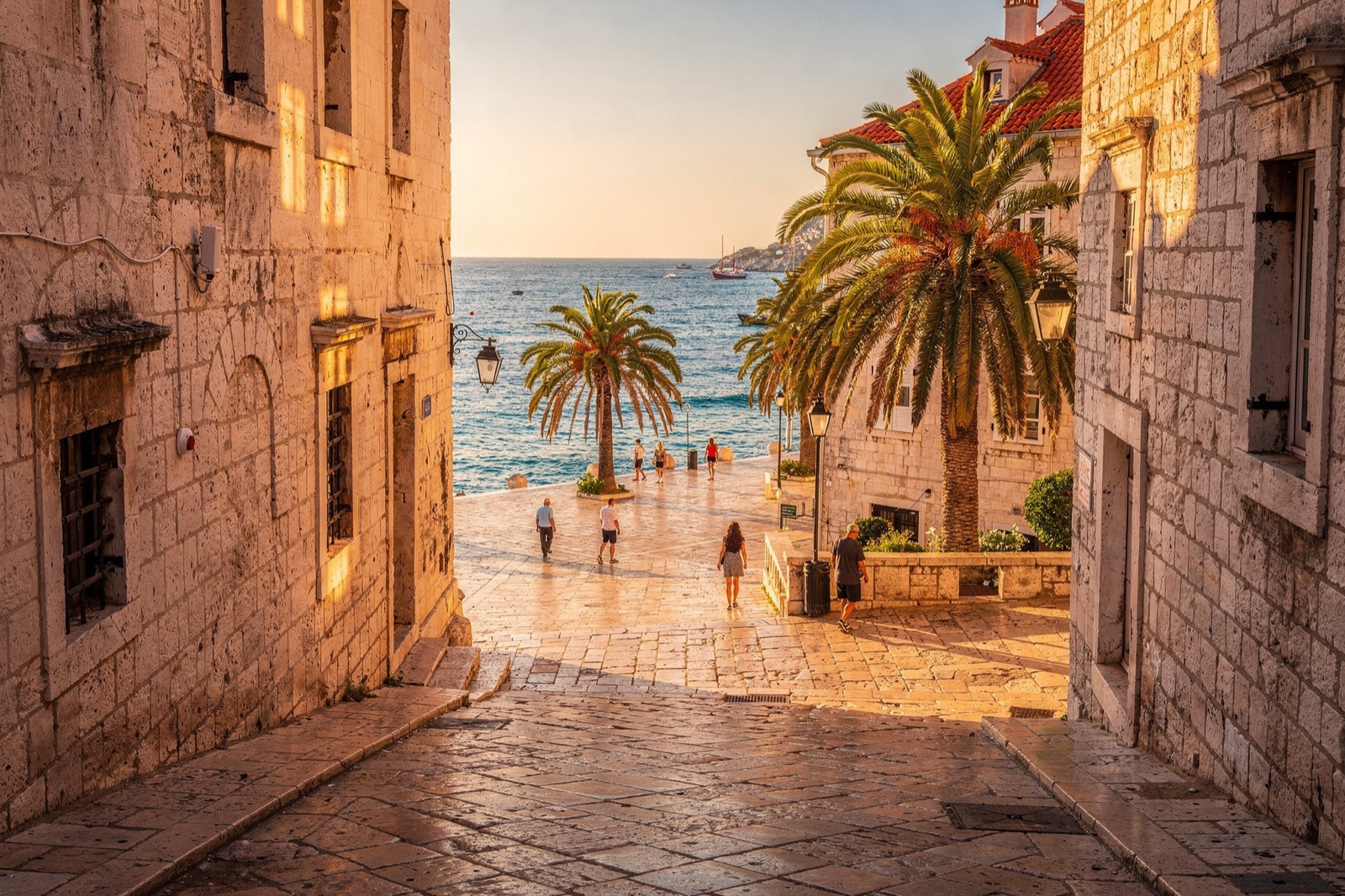
- +Stunning walkable Adriatic old town (Diocletian's Palace), beaches, islands and cafe culture
- +Mediterranean summers with ~2,600 hours of sun and easy ferry/island access
- +Solid acute-care hospital (KBC Split) plus good, affordable English-speaking private clinics
- +Great springboard for travel across Europe and the Adriatic
- +Cost of living well below US coastal cities (single ~$1,000-1,500/mo; couple comfortable ~$2,600/mo)
Worth weighing
- –No retiree visa — only an annually-renewed temporary permit, with inconsistent income expectations and real bureaucratic friction
- –Croatia taxes RESIDENTS on WORLDWIDE income (foreign pensions get a 50% base reduction, but it's not a tax haven)
- –No US-Croatia totalization agreement, so US-tax interplay on Social Security/pensions needs professional planning
- –Winters are cool, wet and dead — coastal businesses shutter Sep-May and the social scene thins
- –Heavy summer tourist crowds, cruise-ship congestion and seasonal price/rent spikes
- –Direct US flights are summer-only; the rest of the year means long connecting trips
- –American-retiree community is modest compared with Portugal or Mexico
Who Split suits
Active retirees who love coastal/Mediterranean living and travel · People who prioritize safety and easy English over warm winters · Summer-focused or part-year residents (snowbirds) comfortable leaving in winter · Culture and history lovers who want a walkable seaside old town
Retirees wanting a simple, dedicated retiree-visa pathway and long-term residency certainty · Those seeking warm, sunny winters year-round · Anyone wanting to minimize taxes (worldwide-income taxation, no totalization agreement) · People who need a large, established American-retiree community · Those who dislike crowds/seasonality or want easy year-round nonstop US flights
What a move to Split actually costs
One form, and up to five international movers come back with real quotes for your move — compare prices before you commit.
Get my moving quotes →Sources, methodology & recent updates · visa & advisory re-checked 2026-10-24SHOW
- Aug 1, 2026We updated Split's visa income requirement to about $994/mo (EUR 870/mo). source ↗
- Jul 4, 2026We updated Split's visa income requirement to about $1,037/mo (EUR 906.6/mo), from ~$525/mo.
Go and see Split first
Flights, a hotel, and a car for the scouting trip — booked in one place, through our travel shop.
See scouting trips to Split →A month in Split before you decide
The people who land happiest came and lived it first — the market, the bus, an ordinary Tuesday — before they signed anything. A furnished place by the week or the month is how you do that.
Partner-marked links may pay Second Summer a referral fee if you choose them. Rankings are never pay-to-rank.
Browse monthly stays in Split on Vrbo →