Montevideo
South America's safest, most stable capital with first-world institutions and a territorial tax that spares your pension, but it's pricey for the region, far from the US, and the winters are damp and gray.
For an American couple, Montevideo runs about $3,000 a month — though the flight home is a long one.
Montevideo by the numbers
Visa & residency for Americans
Low, clearly defined income bar: ~$1,500/mo for a single applicant and ~$2,500/mo for a couple from verifiable passive income (pension, rental, dividends, annuities), as of 2026. Notably, Uruguay grants residency directly and the rentista path leads to PERMANENT residency; you must show income and visit at least once every 3 years to keep it. Citizenship is possible in 3 years (married) or 5 years (single). Process is paperwork-heavy and slow (provisional residency ~2 years while permanent is processed) and is done in-country, but the financial threshold is among the most accessible in the region. Verify current figures with Uruguay's Dirección Nacional de Migración before relying on them.
Your Uruguay residency, mapped to your situation
Where you're headed, who's going, and what you're working with — five questions puts your file on the desk. When a visa specialist clears our bar for your country, you're first in line for the introduction.
Map my Uruguay visa path →What living in Montevideo is actually like
Genuinely strong by Latin American standards. The Hospital Británico (British Hospital, Montevideo) is JCI-accredited with the country's largest concentration of English-speaking doctors and is the default for expats; its private scheme runs ~$325-400+/mo. Most residents instead join a mutualista (IAMC private cooperative) for ~$100-200/mo with small copays. Acute care in Montevideo is reliable. Two catches for this cohort: (1) the best private plans (British Hospital scheme) often cap NEW enrollment around age 60, so over-60 arrivals may be steered to a mutualista such as Médica Uruguaya, cited as having no upper age limit; (2) outside the British Hospital, fluent English among medical staff is uncommon. Nearest world-class care is the British Hospital itself; Buenos Aires (short flight) and the US are fallbacks for ultra-specialized cases.
Health cover for retiring in Uruguay
A broker that compares plans across the major international insurers — including plans that cover you past 65.
Compare plans for Uruguay →Humid temperate with four real seasons. Summers (Dec-Feb) warm, ~28-30C/low-80s; winters (Jun-Jul) chilly and damp, highs ~14C/57F and lows ~7C/45F. Not cold by US standards, but high humidity and the Pampero wind make it feel rawer, and homes are often poorly heated. Winters are notably gray and windy. This is NOT a warm-year-round beach destination; beach season is short (Jan-Feb on the Rambla; Punta del Este nearby).
Uruguay is consistently rated mainland Latin America's safest, most institutionally stable country, with strong rule of law and low political risk. But Montevideo is the soft spot: Numbeo crime index ~56.8 (moderate-to-high, Jun 2026), driven mainly by property crime, theft, and home break-ins; violent street robbery occurs in areas like Ciudad Vieja, the Rambla, and parts of downtown. National homicide rate ~10/100k (elevated for a 'safe' country, though it dipped and robberies fell ~15% in H1 2025). Net: very safe institutionally and far calmer than most of the region, but everyday petty/property crime in the capital is real and rising-trend, so normal big-city precautions apply.
Small, low-key expat scene. Montevideo (~1.4M) has expatriates from various countries, but the American contingent is only a few thousand nationwide, far smaller and less organized than Mexico's or Portugal's enclaves. Argentine and Brazilian neighbors are common; popular expat areas include Pocitos, Punta Carretas, and Carrasco. There's no large ready-made English-speaking retiree bubble, so social integration realistically requires learning Spanish. Punta del Este (a wealthier, more seasonal coastal hub ~2 hrs east) draws more international and second-home residents.
Far from the US. The only nonstop is American Airlines Miami (MIA) to Montevideo (MVD), ~9 hrs, roughly 6x/week (as of early 2026). Everything else routes through Miami, Buenos Aires, São Paulo, Panama, or Santiago, making most US trips ~12-18+ hrs door to door. No direct service to the Northeast/West Coast. Buenos Aires is very close (short flight or ferry) for a regional hub, but transatlantic-distance to family in the US is a genuine drawback for this cohort.
Territorial system: foreign-source pensions and US Social Security are generally NOT taxed in Uruguay. New tax residents from Jan 1, 2026 get 'Tax Holiday 2.0' (up to 10 years' exemption on foreign capital income; after that, foreign passive income is taxed at a flat ~12%). No inheritance/gift tax. Important caveats: there is NO US-Uruguay income tax treaty (only a TIEA for data exchange), so no income-tax treaty relief or tie-breaker rules, but a US-Uruguay Social Security totalization agreement has been in force since Nov 1, 2018. The US still taxes your worldwide income and up to 85% of Social Security regardless. Local IRPF on Uruguay-source income is progressive 10-36%.
Getting your money to Montevideo
Move money across the border at the real exchange rate — the fee shown up front, and you see exactly what lands on the other side.
See how a transfer to Uruguay works →Partner-marked links may pay Second Summer a referral fee if you choose them. Rankings are never pay-to-rank. How partners work
Montevideo, weighed both ways
What’s good
- +Safest, most stable, lowest-corruption country in mainland Latin America, with first-world rule of law and strong democratic institutions
- +Territorial tax plus a 10-year tax holiday means foreign pensions and Social Security are effectively untaxed locally
- +Accessible permanent-residency path: ~$1,500/mo single income bar, leads straight to permanent residency and a fast route to citizenship
- +Strong, affordable healthcare for the region, anchored by the JCI-accredited British Hospital with English-speaking doctors
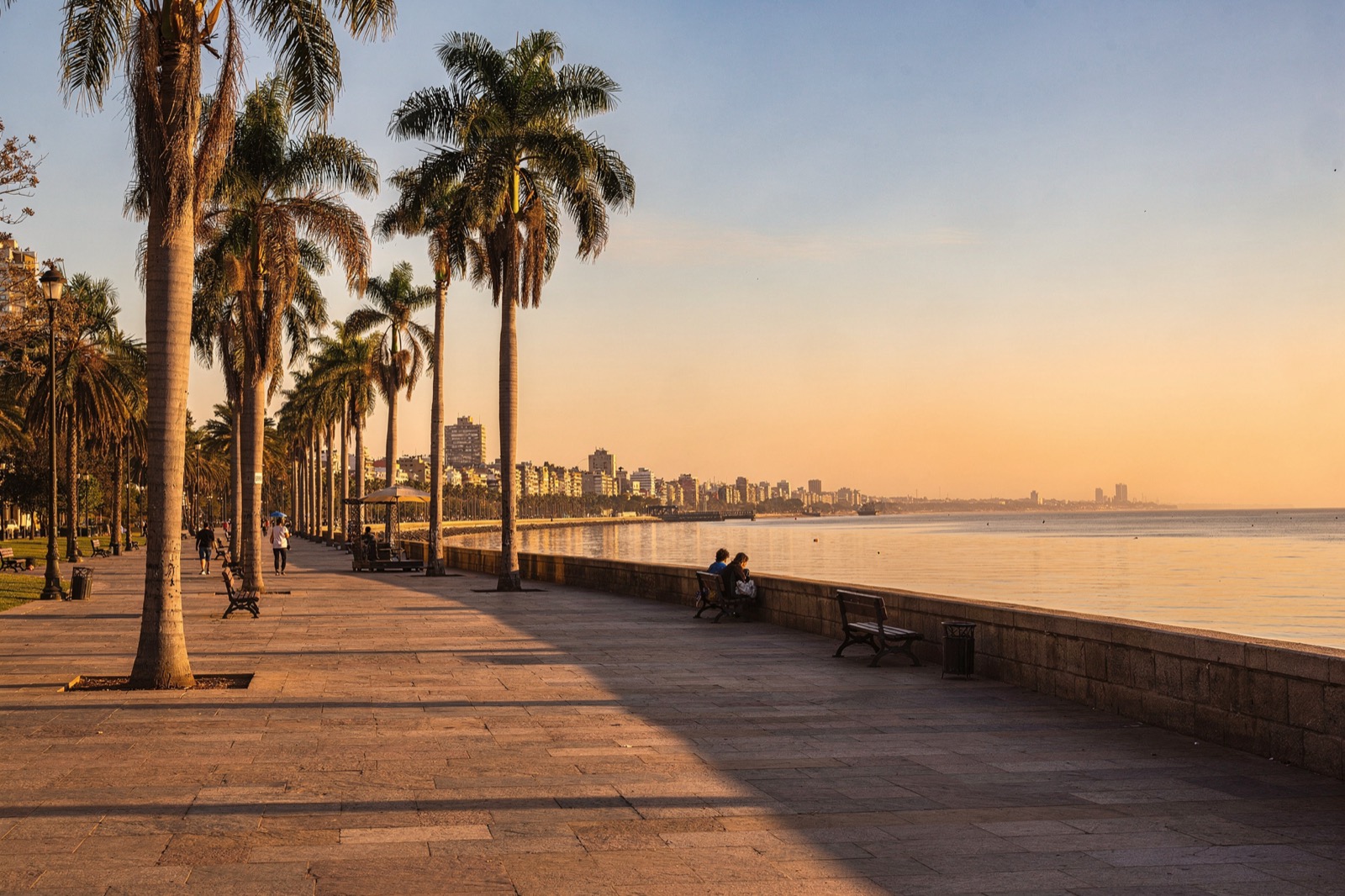
- +Genuinely walkable coastal capital: ~14 mi waterfront Rambla, cafe culture, theaters, low-key European feel, clean and orderly
- +Reliable infrastructure: high renewable-electricity grid, safe tap water, decent internet, and a small efficient size
Worth weighing
- –Most expensive country in Latin America: groceries, cars, electronics, and imported goods are notably pricey, eroding the usual 'cheap abroad' appeal
- –Climate is not warm year-round: damp, gray, windy winters and humidity, with poorly heated homes, so it suits seasons-lovers, not sun-seekers
- –Far from the US with only one nonstop (Miami, ~9 hrs); most trips home are long and connection-heavy
- –Real and rising-trend property/petty crime in Montevideo plus an elevated homicide rate for a 'safe' country, earning a State Dept Level 2 advisory
- –Spanish is essential: limited English in daily life and outside the British Hospital, and only a small American expat community to lean on
- –Bureaucracy is slow and paper-heavy, and there's no US income-tax treaty (only a TIEA), so US worldwide-income filing still applies
Who Montevideo suits
Retirees who prioritize safety, stability, and rule of law above cost or weather · Higher-net-worth couples drawn by the territorial tax and 10-year exemption on foreign income · Walkable-city lovers who want a calm, European-feeling coastal capital over a tropical beach town · People comfortable learning Spanish and content with a small, low-key expat scene
Sun-seekers wanting warm weather year-round (winters are cold, damp, and gray) · Budget retirees chasing the cheapest cost of living (Uruguay is the priciest country in the region) · Anyone who wants frequent, quick, direct trips back to the US · Retirees who want a large ready-made English-speaking expat bubble and to get by without Spanish · Over-~60 arrivals who specifically want top-tier private hospital plans (often age-capped at enrollment)
What a move to Montevideo actually costs
One form, and up to five international movers come back with real quotes for your move — compare prices before you commit.
Get my moving quotes →Sources, methodology & recent updates · visa & advisory re-checked 2026-10-23SHOW
- Aug 7, 2026We updated Montevideo's visa data — the retirement route no longer sets a monthly income requirement. source ↗
Go and see Montevideo first
Flights, a hotel, and a car for the scouting trip — booked in one place, through our travel shop.
See scouting trips to Montevideo →A month in Montevideo before you decide
The people who land happiest came and lived it first — the market, the bus, an ordinary Tuesday — before they signed anything. A furnished place by the week or the month is how you do that.
Partner-marked links may pay Second Summer a referral fee if you choose them. Rankings are never pay-to-rank.
Browse monthly stays in Montevideo on Vrbo →