Palma de Mallorca
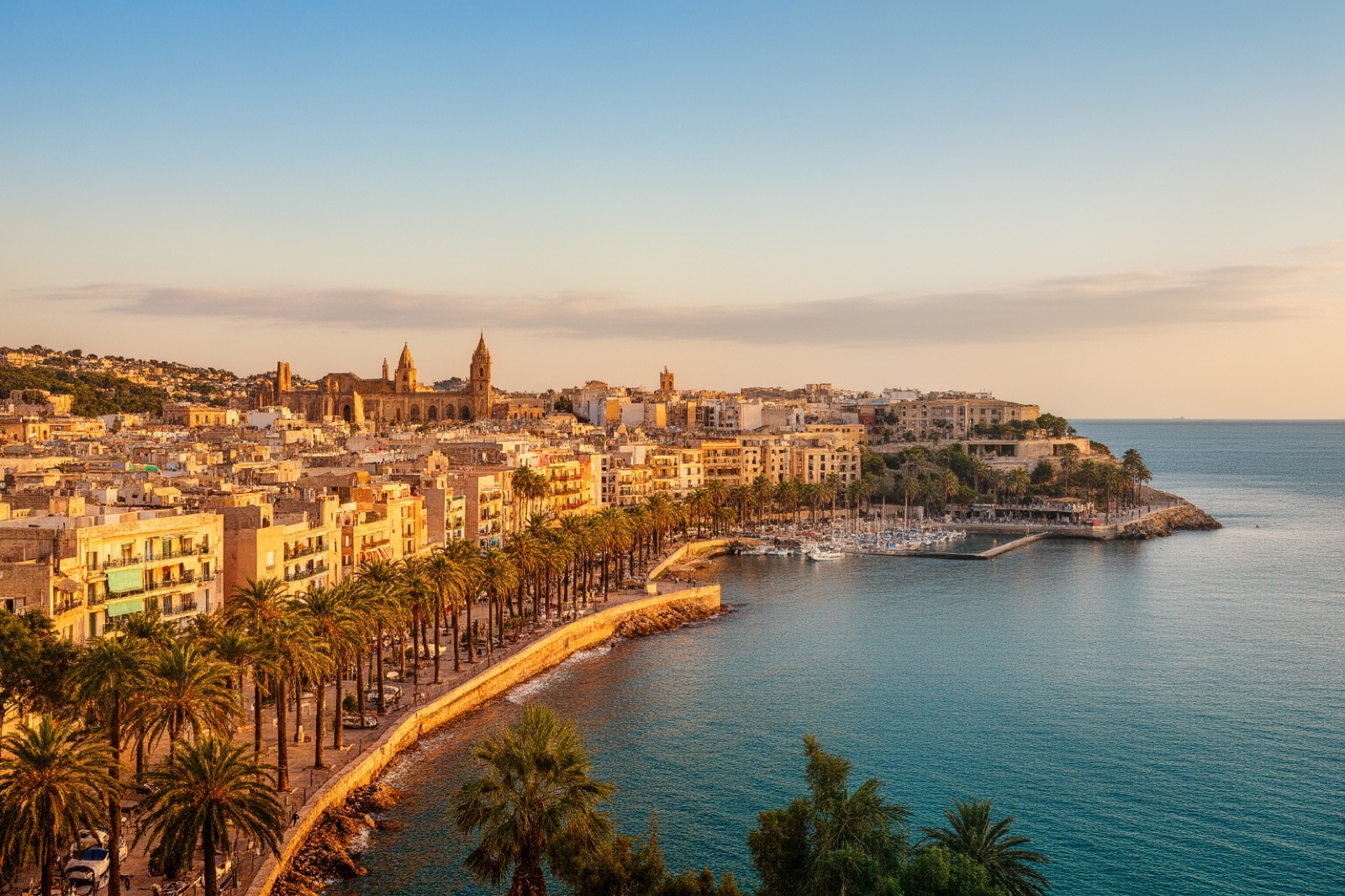
A stylish Mediterranean island capital with mild winters, strong hospitals and a rare year-round US nonstop — but it's pricey, summer-overrun by mass tourism, and island life can feel limiting.
For an American couple, Palma de Mallorca runs about $3,850 a month — with the trip home a hop or a connection away.
Palma de Mallorca by the numbers
Visa & residency for Americans
The NLV is Spain's main passive-income route since the Golden Visa ended in April 2025. 2026 income bar: ~EUR 2,400/mo (~USD 2,740) for the main applicant (400% of IPREM) plus ~EUR 600/mo per dependent, so a couple needs roughly EUR 3,000/mo (~USD 3,420) in passive income or equivalent savings (~EUR 36,000+ for the year). Income must be passive — pensions, Social Security, dividends, rental, investments; remote work does NOT count. Apply at a Spanish consulate in the US, with mandatory Spain-valid private health insurance. Renewable 1+2+2 years; permanent residency at 5 years. Island-specific wrinkle: Mallorca's housing crunch makes securing the required long-term lease or property harder and pricier than the income test itself.
Your Spain residency, mapped to your situation
Where you're headed, who's going, and what you're working with — five questions puts your file on the desk. When a visa specialist clears our bar for your country, you're first in line for the introduction.
Map my Spain visa path →What living in Palma de Mallorca is actually like
Strong for an island. Hospital Universitari Son Espases is the Balearics' supra-regional referral center (cardiology, oncology, neurology, orthopedics and most complex care), backed by public Son Llatzer; together they cover serious cases without leaving the island for most needs. The private sector is excellent and expat-friendly: Clinica Rotger (the only private city-center hospital with 24/7 adult/pediatric A&E, care in Spanish/English), Quironsalud Palmaplanas, and the large multilingual Juaneda network. Private insurance ~EUR 60-120/mo per person, required on the NLV. Spain ranks ~10th globally (Numbeo ~77, 2026). For the rarest specialties, mainland hospitals are a short flight away.
Health cover for retiring in Spain
A broker that compares plans across the major international insurers — including plans that cover you past 65.
Compare plans for Spain →Classic Mediterranean and one of the sunniest spots in Spain. Summers (Jun-Sep) are hot but sea-tempered — coastal highs ~30-33C with warm ~20C nights (inland can hit 40C). Winters are mild, not warm: daytime highs ~15C and nights dipping to ~5C, so it cools off and feels chilly indoors in poorly heated homes. Rain (~400mm/yr at sea level) falls mostly Oct-Mar; summers are bone-dry. The Tramuntana mountains see occasional winter snow.
Palma is comfortably safe — crime is well below big European capitals like London, Berlin or Paris, and Numbeo daytime walk-alone safety scores ~82 (night ~61). Violent crime is infrequent; the realistic risk is petty theft (pickpocketing, bag-snatching) in tourist-dense markets, transport hubs and nightlife zones, which spikes in the summer crush. Women generally report feeling safe walking alone. Areas to steer clear of are the marginalized Son Banya and Maioris districts (drug-related crime) on the city's fringe, well away from where expats live. Spain sits at US State Dept Level 2 (terrorism-driven), which overstates everyday street risk on the island.
Cosmopolitan and very international, but the foreign community skews heavily German and British (with growing Scandinavian and digital-nomad contingents) rather than American. English is widely usable in Palma's expat-facing services, restaurants and private healthcare — an easier landing than mainland inland cities — though some Spanish still helps. The flip side: integration competes with a transient, seasonal, holiday-home crowd, and the American retiree network is small.
Better than most Spanish cities outside Madrid/Barcelona: United flies a year-round nonstop Newark (EWR)-Palma (PMI), ~8.5-9h, the only direct US link. Every other US city connects via Madrid or Barcelona (short, frequent domestic hops) or another European hub. The Newark nonstop is a real perk for East-Coast family ties; West-Coast trips still mean a connection. Within Europe, PMI is a massive, well-connected airport.
Spanish tax residents (183+ days/yr) are taxed on WORLDWIDE income at progressive ~19-47%, and the Balearic Islands re-introduced a regional wealth tax (patrimonio) on larger net worths, alongside Spain's national 'solidarity' tax — so high-net-worth retirees face real wealth-tax exposure here. A US-Spain treaty limits double taxation via foreign tax credits; US Social Security is treaty-assigned to the US but Spain's stance is disputed. Private pensions and 401(k)/IRA drawdowns are generally taxable in Spain. The Beckham regime is for workers, not retirees. Get Balearic-specific cross-border tax advice.
Getting your money to Palma de Mallorca
Move money across the border at the real exchange rate — the fee shown up front, and you see exactly what lands on the other side.
See how a transfer to Spain works →Partner-marked links may pay Second Summer a referral fee if you choose them. Rankings are never pay-to-rank. How partners work
Palma de Mallorca, weighed both ways
What’s good
- +Beautiful island-capital lifestyle — historic old town, marina, beaches and the Tramuntana mountains all close
- +Mild, very sunny Mediterranean winters (no real cold season)
- +Strong healthcare: Son Espases referral hospital plus excellent multilingual private options
- +Rare year-round nonstop to Newark (~8.5-9h) — unusual for a Spanish city this size
- +Cosmopolitan, English-friendly, with good infrastructure and a big well-connected airport
- +Safe day and night, with low violent crime
- +Stylish food, sailing and outdoor scene with a high quality of life
Worth weighing
- –Expensive by Spanish standards — rents ~EUR 1,100-1,480 for a 1BR and an acute housing crunch make securing a long-term lease hard
- –Mass tourism overwhelms the island in summer (millions of visitors; locals priced off their own beaches)
- –Island life can feel limiting — higher prices on imported goods, fewer specialized services, a 'small world' feel off-season
- –Balearic wealth tax plus Spain's worldwide-income taxation (up to ~47%) hit higher-net-worth retirees
- –Expat scene is German/British-dominated; the American retiree community is small
- –Winters are mild but cool, and homes are often poorly heated
- –Spain carries a US State Dept Level 2 advisory (terrorism-driven)
- –Petty theft rises sharply during the summer tourist crush
Who Palma de Mallorca suits
Retirees who want island/coastal Mediterranean living with city amenities · East-Coast-based couples who value a rare year-round nonstop home · Sun-lovers who want mild winters without extreme summer inland heat · Those happy in an international, English-friendly, somewhat transient community
Budget retirees — this is one of Spain's pricier housing markets · Anyone who'd chafe at summer mass-tourism crowds and seasonal swings · Higher-net-worth individuals unwilling to navigate the Balearic wealth tax · People who want a deep, year-round local community and dislike island insularity
What a move to Palma de Mallorca actually costs
One form, and up to five international movers come back with real quotes for your move — compare prices before you commit.
Get my moving quotes →Sources & methodology · visa & advisory re-checked 2026-10-20SHOW
Go and see Palma de Mallorca first
Flights, a hotel, and a car for the scouting trip — booked in one place, through our travel shop.
See scouting trips to Palma de Mallorca →A month in Palma de Mallorca before you decide
The people who land happiest came and lived it first — the market, the bus, an ordinary Tuesday — before they signed anything. A furnished place by the week or the month is how you do that.
Partner-marked links may pay Second Summer a referral fee if you choose them. Rankings are never pay-to-rank.
Browse monthly stays in Palma de Mallorca on Vrbo →