Querétaro
A safe, prosperous highland colonial city with a spring-like climate and strong hospitals — but a small expat scene, modest US flights, and everyday life that demands Spanish.
For an American couple, Querétaro runs about $2,150 a month — with the trip home a hop or a connection away.
Querétaro by the numbers
Visa & residency for Americans
As of 2026, the Temporary Resident (passive-income) route requires roughly US$4,400/month in stable income (pension, Social Security, dividends) over ~6 months, OR an average ~US$74,000 in savings/investments over 12 months. Thresholds moved to UMA-pegging in 2025 (2026 UMA MXN 117.31), keeping the bar roughly flat. Add ~25% (~$925/mo) for a spouse/dependent. You apply at a Mexican consulate abroad, then finalize the canje in Mexico within 30 days; the card renews up to 4 years, after which you can convert to permanent residency. Consular fees rose for 2026 and interpretation varies by consulate — confirm with the one you'll use. Querétaro's INM office is generally considered efficient by expat accounts, but allow time for in-country paperwork.
Your Mexico residency, mapped to your situation
Where you're headed, who's going, and what you're working with — five questions puts your file on the desk. When a visa specialist clears our bar for your country, you're first in line for the introduction.
Map my Mexico visa path →What living in Querétaro is actually like
Strong private healthcare for a mid-size city. Hospital Ángeles Querétaro and Star Médica Querétaro are the go-to private hospitals — full-service, modern, with specialists across cardiology, ortho, oncology and more, plus options like Hospital del Parque and Hospital H+ Querétaro. Costs run roughly 25-50% of US prices, and major chains generally have some English-speaking staff (though less internationally-oriented than Mérida or Cabo, so confirm per doctor). Public IMSS/ISSSTE exist; most expats self-pay or carry private insurance. For the most complex cases, Mexico City's top-tier hospitals (ABC, Médica Sur) are ~2.5-3h by road or a short flight — that's the nearest world-class tier.
Health cover for retiring in Mexico
A broker that compares plans across the major international insurers — including plans that cover you past 65.
Compare plans for Mexico →High-desert 'eternal spring' at ~1,820-1,900m. Mild and temperate most of the year: typical days run ~55-85°F, rarely below ~36°F or above ~91°F. Spring (Mar-May) is the warmest and driest; a Jun-Sep rainy season brings afternoon showers. Winter nights and early mornings get genuinely chilly (40s°F) and many homes lack central heating, so indoor cold is a real if minor caveat. Drier and less humid than coastal Mexico.
One of Mexico's safest and most prosperous cities — a frequent top performer on the Mexico Peace Index, with a homicide rate (~8/100,000) well below the national ~25. Querétaro state, however, sits at US State Dept Level 2 ('Exercise Increased Caution'), the broad default for most of central Mexico. Everyday risk for residents is petty crime: pickpocketing at bus stations and markets, occasional car break-ins, and standard scam awareness. Safer neighborhoods favored by expats include Juriquilla, Zibatá, El Refugio, El Campanario, and the well-patrolled UNESCO Centro Histórico. Women generally report it as comfortable and walkable by day, with normal big-city caution at night.
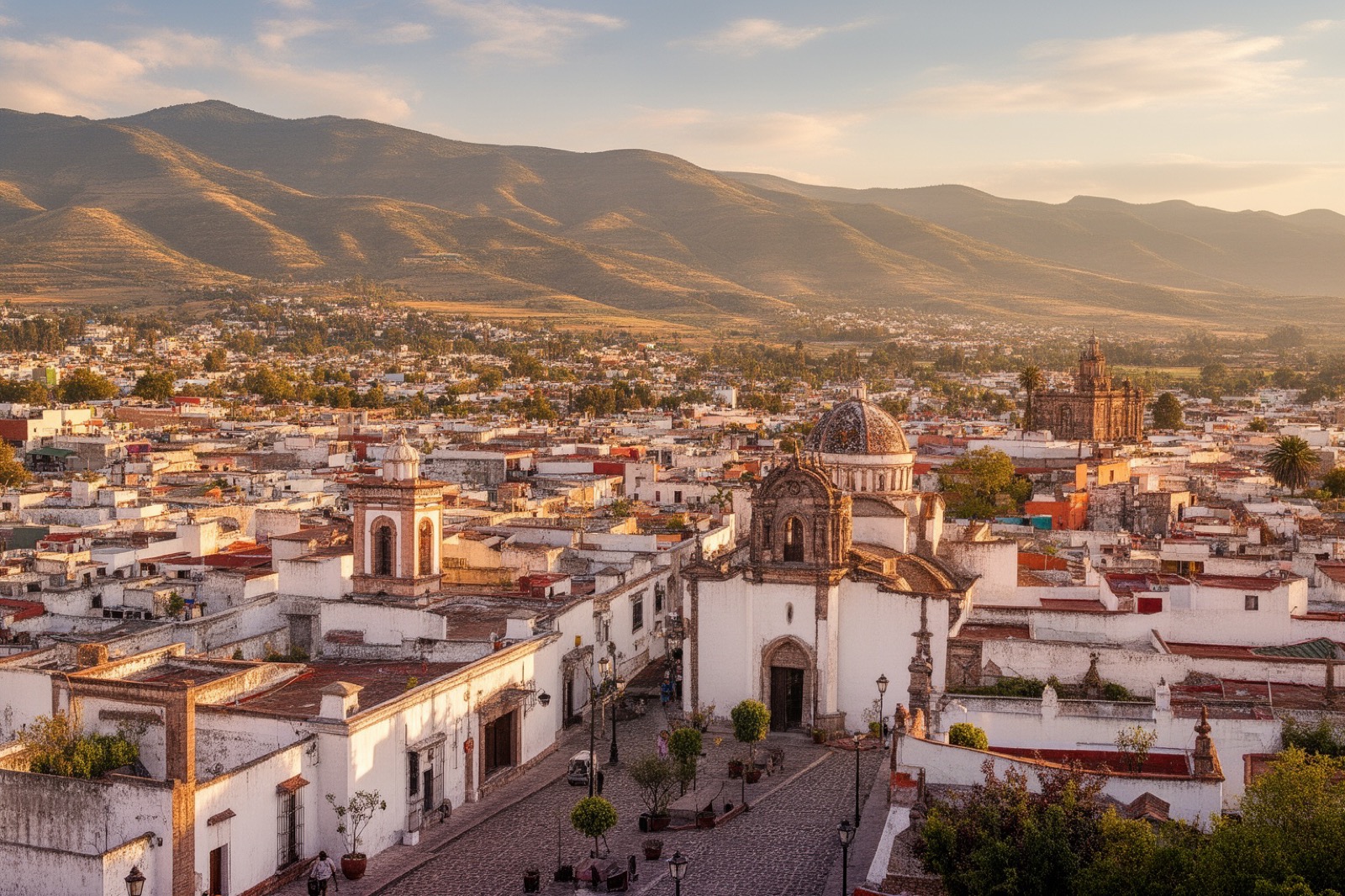
Querétaro is a working, fast-growing Mexican industrial and tech hub with a real but modest foreign community — more corporate transferees, Mexican professionals, and a steadily growing retiree trickle than a tourist-driven expat bubble. There are Facebook groups, international schools, and English-speaking services, but daily life leans heavily Spanish and it lacks the mature retiree infrastructure of San Miguel de Allende (~1h away). Great for immersion, less so for an English-only landing.
Querétaro Intercontinental (QRO) has direct US service but modest frequency — Houston and Dallas-Fort Worth are the workhorses (United, American, plus low-cost Viva and Volaris), roughly 2-2.5h, with a handful of other limited US routes. No nonstop to the coasts; most trips connect through Houston/Dallas or via Mexico City (~2.5-3h by road, very frequent flights). Good for Texas-based family, more of a connection for everyone else.
Mexican tax residents are technically taxed on worldwide income, but in practice it's territorial-leaning for retirees: the US-Mexico tax treaty (in force 1994) generally assigns US Social Security and government pensions to the US, and US-source private pensions/IRA/401(k) withdrawals are typically not taxed by Mexico for US citizens. US citizens still file and owe US tax (treaty saving clause). No US-Mexico Social Security totalization agreement. We're not tax advisors — confirm specifics with a cross-border professional.
Getting your money to Querétaro
Move money across the border at the real exchange rate — the fee shown up front, and you see exactly what lands on the other side.
See how a transfer to Mexico works →Partner-marked links may pay Second Summer a referral fee if you choose them. Rankings are never pay-to-rank. How partners work
Querétaro, weighed both ways
What’s good
- +Among Mexico's safest and most prosperous cities, with a beautiful UNESCO colonial center
- +Mild, spring-like highland climate year-round — no coastal heat or humidity
- +Strong, affordable private hospitals (Ángeles, Star Médica)
- +Clean, modern, well-run city with good services and nearby wine/cheese country
- +~1h to San Miguel de Allende and ~2.5-3h to Mexico City
- +Treaty-protected US pensions/Social Security generally not taxed by Mexico
Worth weighing
- –Small, less-established expat scene — thin English-only infrastructure
- –Limited direct US flights (mainly Houston/Dallas); coasts require a connection
- –Functional Spanish is close to essential for daily life
- –No beach and no big-city nightlife/culture density of CDMX
- –Chilly winter nights in often-unheated homes
- –Rapid industrial/population growth brings traffic and sprawl on the outskirts
- –Worldwide-income tax residency rules require care/advice despite treaty relief
Who Querétaro suits
Safety-first retirees wanting an authentic, prosperous Mexican city · Couples who prefer a mild highland climate to coastal heat · Those who want (or don't mind) Spanish immersion over an expat bubble · Walkable-lifestyle lovers near wine country and central-Mexico day trips
Retirees wanting a large, English-speaking expat community · Anyone who needs frequent direct flights to the US coasts · Beach seekers or those wanting tropical warmth · People unwilling to learn functional Spanish
Sources, methodology & recent updates · visa & advisory re-checked 2026-10-26SHOW
- Aug 17, 2026We re-checked a reported change to Querétaro's figures against official sources — no change; they stand as shown.
Go and see Querétaro first
Flights, a hotel, and a car for the scouting trip — booked in one place, through our travel shop.
See scouting trips to Querétaro →A month in Querétaro before you decide
The people who land happiest came and lived it first — the market, the bus, an ordinary Tuesday — before they signed anything. A furnished place by the week or the month is how you do that.
Partner-marked links may pay Second Summer a referral fee if you choose them. Rankings are never pay-to-rank.
Browse monthly stays in Querétaro on Vrbo →