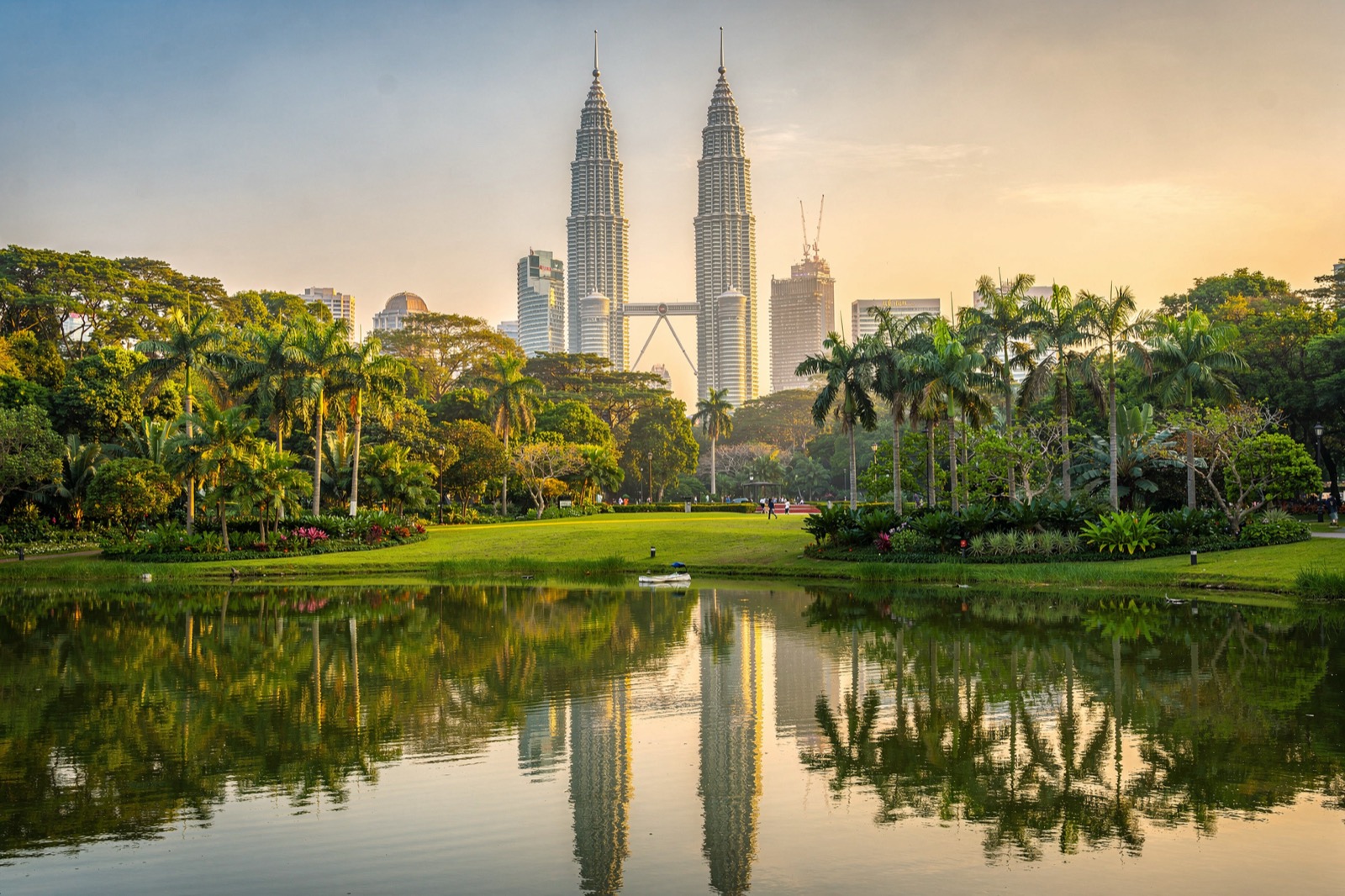
Kuala Lumpur
A modern, English-fluent, dirt-cheap Asian capital with world-class hospitals — but it's a punishing distance from the US and the once-easy retiree visa is now capital-heavy.
For an American couple, Kuala Lumpur runs about $2,500 a month — though the trip home is a true long haul.
Kuala Lumpur by the numbers
Visa & residency for Americans
Kuala Lumpur has no cheap retiree visa. The federal MM2H, relaunched in 2024, replaced its income test with locked-up capital: the entry Silver tier takes a USD 150,000 fixed deposit in a Malaysian bank plus a home purchase of at least RM 600,000 (roughly $150,000) within 12 months of approval, held for 10 years, for a 5-year renewable pass. Gold (USD 500,000 deposit, RM 1 million home, 15 years) and Platinum (USD 1 million, RM 2 million, 20 years) go higher. There is no monthly income requirement on any federal tier, no minimum stay once you are 50 or older (under 50: 90 days a year), and up to half the deposit can be withdrawn after approval for the home, medical care or schooling. The income-based alternative, Sarawak's S-MM2H, was tightened on 1 Jan 2025: a mandatory RM 500,000 deposit in a Sarawak bank plus offshore income of RM 10,000 a month (RM 15,000 with dependants) or RM 100,000/200,000 in proven savings, age 30+, 30 days a year in Sarawak, and it ties you to Borneo, not KL. Plan on six figures of capital for the capital. Sources: MOTAC's official MM2H portal, mm2h.gov.my (category pages last updated 10 Feb 2026) and the Sarawak tourism ministry's S-MM2H requirements notice (effective 1 Jan 2025); checked 6 Sep 2026.
Your Malaysia residency, mapped to your situation
Where you're headed, who's going, and what you're working with — five questions puts your file on the desk. When a visa specialist clears our bar for your country, you're first in line for the introduction.
Map my Malaysia visa path →What living in Kuala Lumpur is actually like
A genuine medical-tourism hub. Top private hospitals (Prince Court, Gleneagles KL, Pantai, Sunway) offer Western-standard acute and specialist care with US/UK/Australia-trained, English-speaking doctors, and at a fraction of US prices — a specialist visit often runs USD 15-40 out of pocket. Prince Court Medical Centre is frequently ranked among the best hospitals for medical tourists globally, so world-class care is in-city, not a flight away. Caveat: public hospitals are cheap but crowded and best avoided by expats; budget for private insurance, which gets materially more expensive after ~70.
Health cover for retiring in Malaysia
A broker that compares plans across the major international insurers — including plans that cover you past 65.
Compare plans for Malaysia →Hot, humid and equatorial all year — daytime highs ~31-33C (88-91F) every month with high humidity and near-daily afternoon thunderstorms. No real seasons and no cool relief; air-conditioning is a way of life. The haze from regional agricultural burning (roughly Jul-Oct) can periodically push air quality into unhealthy ranges.
US State Dept: Level 1 (Exercise Normal Precautions), as of Feb 2026 — among the safest tiers, with a localized Level 2 carve-out only for the islands/maritime areas off eastern Sabah (kidnapping risk), which is irrelevant to KL. Violent crime against foreigners is rare. The real day-to-day risks are petty: motorcycle bag-snatching (sometimes causing falls/injury), pickpocketing in crowds, credit-card skimming, and a high volume of phone/online scams. Numbeo's KL safety index sits around the low-40s (moderate), reflecting these property-crime concerns rather than danger to life.
A large, well-established and diverse expat scene — Western retirees, Japanese/Korean/Chinese expats, oil-and-gas professionals, digital nomads and a big Middle Eastern community. Expat enclaves cluster in Mont Kiara, Bangsar, KLCC and Damansara, with international schools, Western groceries, English-language meetups and active Facebook/forum communities. It's more of a working/nomad expat hub than a dedicated retiree colony (unlike Penang, which skews older), but you will not be isolated.
Brutal from the US. There are no nonstop flights between Kuala Lumpur and North America; every routing requires at least one connection (commonly via Tokyo, Hong Kong, Taipei, Doha, Dubai or Istanbul), with total door-to-door travel typically 22-30+ hours. KLIA is a major, well-connected hub for the rest of Asia, so regional travel is cheap and easy — but visits to/from US family are a long-haul, jet-lag-heavy commitment.
Territorial system: residents are taxed on Malaysian-source income only, and foreign-source income (US pensions, Social Security, investment income) is exempt even when remitted under current rules. Resident earned-income rates are progressive (~0-30%). Critically, there is NO US-Malaysia income tax treaty — so no treaty relief, restricted foreign tax credits, and US-taxable treatment of things like EPF; FATCA reporting does apply (Malaysian banks report US persons). US citizens still owe US tax/filing worldwide. Source: PwC Worldwide Tax Summaries (Malaysia). Verify with a cross-border tax advisor.
Getting your money to Kuala Lumpur
Move money across the border at the real exchange rate — the fee shown up front, and you see exactly what lands on the other side.
See how a transfer to Malaysia works →Partner-marked links may pay Second Summer a referral fee if you choose them. Rankings are never pay-to-rank. How partners work
Kuala Lumpur, weighed both ways
What’s good
- +Among the cheapest world-class cities anywhere: a couple can live very comfortably in a modern high-rise condo (pool/gym) for ~USD 2,500/mo, far below a comparable US lifestyle
- +English is a de facto working language (former British colony) — you can handle doctors, banks, leases and bureaucracy without learning Malay
- +Excellent, affordable private healthcare with internationally trained, English-speaking specialists and globally ranked hospitals in the city
- +Territorial tax system: foreign pensions, Social Security and other foreign-source income are not taxed by Malaysia
- +Modern infrastructure — fast cheap internet, KLCC/Bukit Bintang malls, an expanding MRT/LRT metro, Grab ridehailing, and a spectacular, cheap food scene (Malay, Chinese, Indian)
- +Strong regional hub: easy, inexpensive flights all over Asia for travel
Worth weighing
- –Very far from the US with zero nonstop flights — 22-30+ hour trips make seeing family hard and rule it out for anyone who needs to be reachable to the US quickly
- –No cheap retiree visa for KL anymore: the reformed federal MM2H demands a ~USD 150k bank deposit plus property purchase, and the income-based S-MM2H (tightened in 2025) requires living in Sarawak, not the capital
- –Relentless heat, humidity and near-daily storms year-round, plus seasonal haze — there is no cool season or seasonal variety
- –No US-Malaysia tax treaty: more US filing friction (FATCA reporting applies) and foreign tax credits are restricted, so retirement-account/EPF interactions can be messy — get a cross-border CPA
- –Petty crime and scams are common (bag-snatching, skimming, phone/online fraud), and traffic, congestion and pedestrian-hostile streets outside the core wear on you
- –Alcohol is heavily taxed/expensive and it's a Muslim-majority country (modest dress at some sites, Ramadan rhythms) — a cultural adjustment for some
Who Kuala Lumpur suits
Budget-conscious retirees who want a modern big-city lifestyle and top healthcare at a fraction of US cost · English-only speakers who want zero language barrier in Asia · Adventurous expats who travel widely in Asia and value KL as a cheap, connected hub · Anyone with the capital to fund MM2H who prioritizes healthcare quality and cost of living over proximity to home
Retirees who need to fly back to the US often or quickly · Anyone unwilling to lock up six figures (deposit + property) for residency in the city itself · People who can't tolerate constant tropical heat and humidity with no seasons · Those wanting a quiet, walkable small town rather than a sprawling, traffic-heavy megacity
What a move to Kuala Lumpur actually costs
One form, and up to five international movers come back with real quotes for your move — compare prices before you commit.
Get my moving quotes →Sources, methodology & recent updates · visa & advisory re-checked 2026-10-24SHOW
- Oct 10, 2026We re-checked a reported change to Kuala Lumpur's figures against official sources — no change; they stand as shown.
- Jul 4, 2026We updated Kuala Lumpur's visa data — the retirement route no longer sets a monthly income requirement.
Go and see Kuala Lumpur first
Flights, a hotel, and a car for the scouting trip — booked in one place, through our travel shop.
See scouting trips to Kuala Lumpur →A month in Kuala Lumpur before you decide
The people who land happiest came and lived it first — the market, the bus, an ordinary Tuesday — before they signed anything. A furnished place by the week or the month is how you do that.
Partner-marked links may pay Second Summer a referral fee if you choose them. Rankings are never pay-to-rank.
Browse monthly stays in Kuala Lumpur on Vrbo →